
MathMaster
An untimed multiple-choice math game from first sums to advanced algebra and competition-style problems.
A child solves one question at a time, from early arithmetic and missing numbers through percentages and equations. Selected problem types continue beyond Grade 12 into university-foundation, competition-style, and Olympiad/Honors problems for older learners and adults.
In the app, MathMaster creates new questions during play. Every app question includes solving steps for that exact problem and its numbers, while linked glossary entries explain unfamiliar terms. The examples on this website stay fixed.
- Untimed
- Read one problem and choose an answer without racing a clock.
- 16 problem types
- Arithmetic, percentages, factors, equations, systems, and more.
- 85 levels
- Preschool through Grade 12, then four Advanced Challenge bands.
- Exact explanations
- Each app problem has its own solving steps; linked terms open glossary help.
See one complete MathMaster turn
The math changes from early arithmetic to advanced algebra, but the action stays simple: read one question and choose an answer. After a mistake, the app marks the correct answer and, when explanations are on, opens the solving steps.
- 1
Read one new question
MathMaster chooses a kind of math available at the child's current difficulty, then builds the question.
- 2
Choose an answer
The child taps one of the displayed choices.
- 3
See the result
A correct choice is confirmed. After a miss, MathMaster also marks the correct answer.
- 4
Learn from the same problem
With explanations switched on, the app opens solving steps for the exact question and numbers just shown. Linked terms open glossary help.
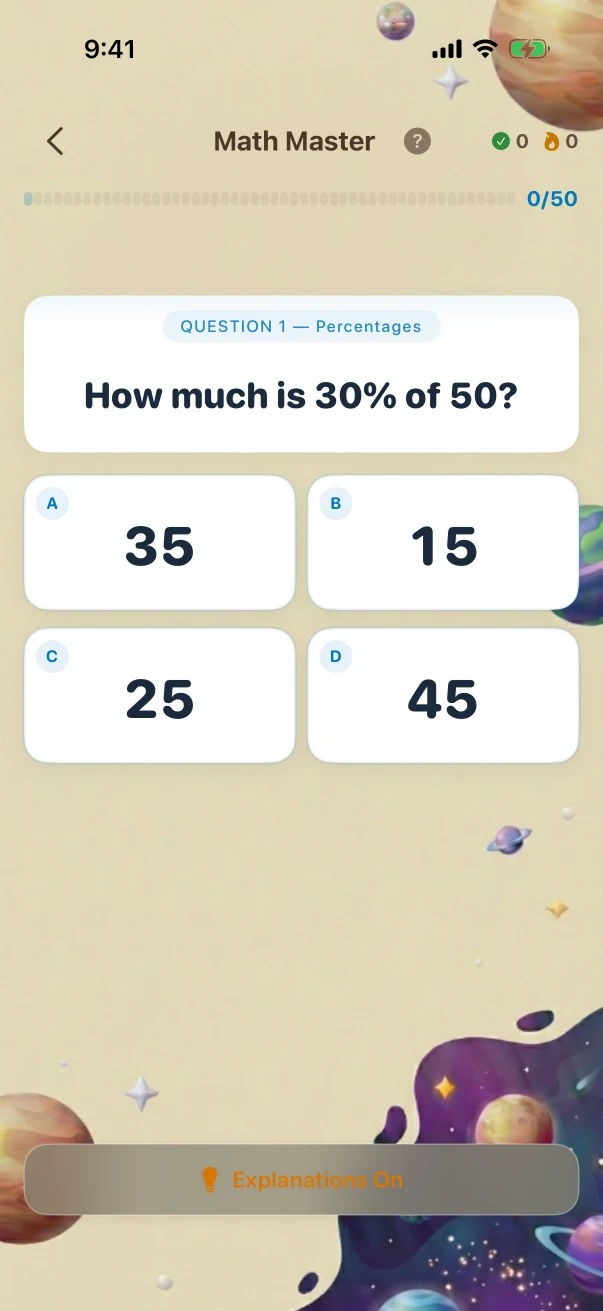
Sixteen problem types cover arithmetic, number sense, and algebra
A problem type is a broad task, such as comparing values, finding a missing number, or solving an equation. Choose any type to compare how it starts with a structurally different later challenge. Every example shows its exact MathMaster level.
Explore all 16 problem types
Choose a type to see what it teaches, where it appears across 85 levels, which standards it supports, and a real example problem.
Arithmetic
Your child practices core math: addition, subtraction, multiplication, and division.
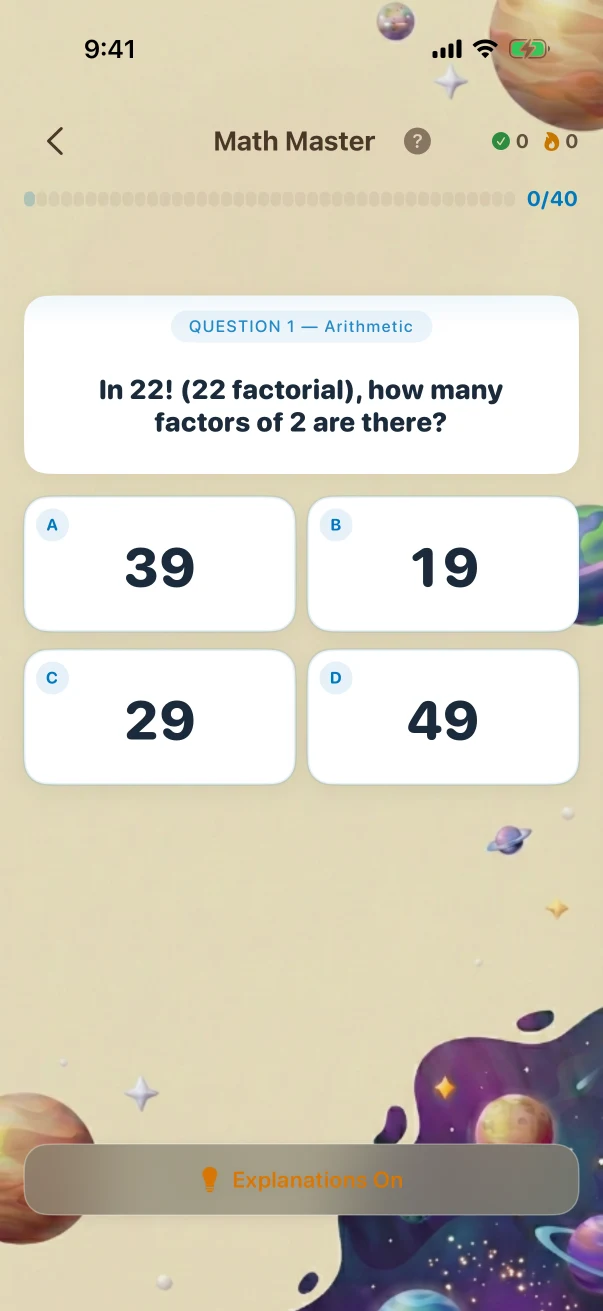
A one-step addition becomes counting how many times the factor 2 appears in a factorial.
Arithmetic · Later challenge · MathMaster level 85
- What the child is solving
- In 22! (22 factorial), how many factors of 2 are there?
- Answer
- 19
- Here's how
- Legendre's formula: count factors of prime p in n! by summing ⌊n/p⌋ + ⌊n/p2⌋ + ⌊n/p3⌋ + … Each term counts multiples of higher powers.
The child is viewing the task before submitting an answer.
For educators: each code points to the plain-language skill named above; it does not set a child's grade.
Arithmetic. Later challenge. MathMaster level: 85.
How MathMaster chooses, builds, and explains one question
From the child's MathMaster level to one equation
a(x + b) = cx + d3(x + 4) = x + 42, x = ?MathMaster builds wrong choices from common mistakes, then removes duplicates and choices that are obviously implausible.
First, the session chose Linear equations from the problem types available at Level 46. MathMaster then made several questions with that level's equation form, compared their difficulty, and served the closest match. That comparison chooses among generated questions; it does not choose the subject.
MathMaster explains the same equation and numbers
This example deliberately follows one wrong choice. MathMaster marks the accepted answer and, when explanations are on, opens the exact app explanation for this equation plus linked glossary help. The app explains how to solve the problem without claiming to know why that answer was chosen.
After the wrong choice. 3(x + 4) = x + 42, x = ?
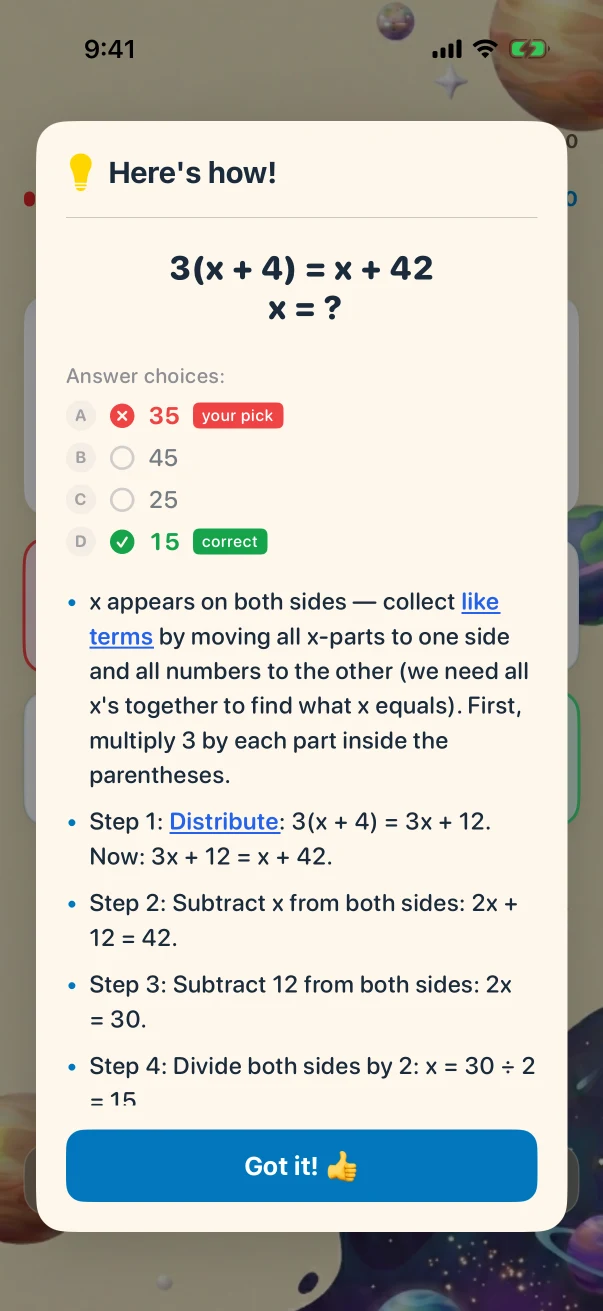
Step-by-step explanation for the same question
3(x + 4) = x + 42, x = ?- 1x appears on both sides — collect like terms by moving all x-parts to one side and all numbers to the other (we need all x's together to find what x equals). First, multiply 3 by each part inside the parentheses.
- 2Step 1: Distribute: 3(x + 4) = 3x + 12. Now: 3x + 12 = x + 42.
- 3Step 2: Subtract x from both sides: 2x + 12 = 42.
- 4Step 3: Subtract 12 from both sides: 2x = 30.
- 5Step 4: Divide both sides by 2: x = 30 ÷ 2 = 15.
- 6Check: 3(15 + 4) = 3(19) = 57, and 15 + 42 = 57 ✓
- 7Formula: a(x + b) = cx + d → (a−c)x = d − ab → x = (d − ab) ÷ (a−c).
- 8Answer: x = 15.
Every MathMaster problem in the app includes its own explanation. When explanations are on, a mistake opens it automatically.
How results can shape later practice
MathMaster keeps a practice history inside this game. Once enough history exists, it can use that record when choosing later work.
Sessions mix problem types
A session mixes problem types available near the child's level and does not show the same type twice in a row.
Practice can return where needed
After MathMaster has enough history, a type can appear more often if it has not been practised recently or has been harder for the child. Answers also help adjust later difficulty.
MathMaster has its own level
MathMaster keeps its own difficulty and practice history for the child, separate from progress in every other game.
See how the math changes from Level 1 to Level 85
The child has one current MathMaster level on the 85-level path. Inside each problem type, separate difficulty stages change the rule, question form, or number of solving steps. Not every type starts at Level 1 or remains active through Level 85.
MathMaster's estimate of the right difficulty for this child. It places practice from Preschool through Grade 12 and the Advanced Challenge Track.
Each type has its own sequence of difficulty versions. A later version can require a different method, not merely larger numbers.
Exponent-rule questions change from one rule to a multi-rule final challenge
The question does not merely use larger numbers. The later version combines several exponent rules and then asks the player to reason about a repeating last-digit pattern.
Apply one exponent rule
(42)2 = ?Recognise a power raised to another power and multiply the two exponents.
Combine rules, then find a number pattern
What is the last digit of (34 × 95)12 ÷ 275?Rewrite the related bases as powers of 3, combine the exponents, and use the repeating last-digit cycle to finish.
What the player has to do- Rewrite every factor as a power of 3.
- 9 = 32 and 27 = 33, so the expression becomes a single power of 3.
- The exponent is 12(4 + 2×5) − 3×5 = 153.
- Because the last digit of a power depends only on the last digit of the previous power, the last digits must repeat in a short fixed cycle: powers of 3 cycle as 3, 9, 7, 1.
- 153 ÷ 4 leaves remainder 1, so use cycle position 1.
- 153 lands on last digit 3.
What changed: The early question uses one exponent rule. The Level 85 question combines several exponent rules with a repeating last-digit pattern.
- 01PreschoolLevels 1-5
First arithmetic and comparison questions use small values and direct one-step decisions.
- 02Grades 1-5Levels 6-30
Place value, true equations, missing numbers and signs, number properties, and deeper operations enter the mix.
- 03Grades 6-8Levels 31-45
Percentages, factors and multiples, powers, exponent rules, and linear equations add new forms and more steps.
- 04Grades 9-12Levels 46-65
Active types move into denser algebra, including more demanding linear, quadratic, system, and exponent work.
- 05Advanced Challenge TrackLevels 66-85
Four five-level bands take selected types beyond school: Advanced Bridge (66-70), Competition Expert (71-75), University Foundations (76-80), and Olympiad / Honors Synthesis (81-85). Questions become less direct, combine methods, and demand more planning.
What you can try on the website and what is in the app
A limited browser puzzle, not the complete 16-type catalog or a session that follows the child's MathMaster level.
Generated sessions, a MathMaster level that follows the child, parent controls, exact explanations, and glossary support. The app can keep creating core practice questions if the internet drops temporarily; syncing family data still needs a connection.